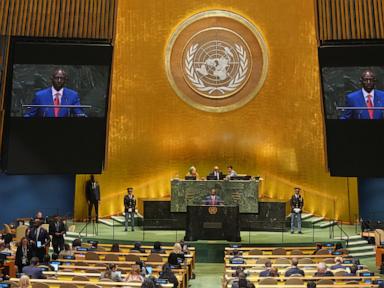
The United Nations Security Council looks like a relic of 1945 because that is exactly what it is. When the organization designed its highest decision-making body after World War II, a continent of over a billion people was absent, largely bound by colonial rule. Today, African leaders are back at the General Assembly demanding an end to this historic exclusion. They aren't asking for a favor. They're demanding basic global equity.
Let's look at the numbers. Africa makes up roughly 28 percent of all UN member states and accounts for a population of 1.6 billion people. Yet, the 15-member Security Council only gives the continent three non-permanent seats that rotate every two years. Permanent power and the almighty veto remain locked in the hands of five nations: the United States, Russia, France, the United Kingdom, and China.
It's an indefensible imbalance. Kenyan President William Ruto put it bluntly during the assembly, noting that while nations are supposed to be equal under the UN charter, that equality stops abruptly at the doors of the Security Council.
The Cost of Being Left Out
Why should you care about who sits on a council in New York? Because the security crises debated in that room directly impact millions of lives, yet the regions carrying the heaviest burdens are kept away from the primary steering wheel.
Think about the major conflicts driving global headlines, from the war in Ukraine to crises across Sudan and the Democratic Republic of Congo. African nations navigate these shocks daily, often bearing the financial and operational brunt of regional peacekeeping missions themselves. South African International Relations Minister Ronald Lamola pointed out that African states have frequently financed and carried out their own security operations at their own cost, while receiving little structural backing from global systems.
When you do the heavy lifting of peacekeeping without a permanent seat at the table, you're basically expected to accept decisions made by outsiders. African leaders are saying those days are over.
Moving Past Empty Promises
Diplomatic lip service isn't cutting it anymore. Back in 2024, the United States expressed support for adding two permanent African seats to the council. But statements from shifting political administrations haven't translated into actual structural change. Liberia's President Joseph Nyuma Boakai called the ongoing exclusion an untenable historical injustice that damages the entire credibility of the UN.
The African Union has long stuck to the Ezulwini Consensus, demanding at least two permanent seats for the continent, complete with veto power if vetoes remain a privilege for others. Namibian President Netumbo Nandi-Ndaitwah captured the mounting frustration cleanly, stating that the time for endless negotiation has expired.
Beyond Traditional Security
This fight isn't just about military conflicts or old geopolitical rivalries. The modern global agenda brings entirely new frontiers, like artificial intelligence, critical minerals, and rare earth resources.
Botswana President Duma Boko warned delegates that developing nations must have a genuine voice in shaping the rules and standards governing these emerging technologies. Most of the critical materials fueling global tech innovations come from developing regions. If those regions are shut out of high-level governance, the resulting frameworks will ignore local rights, human dignity, and economic security.
Reform isn't an attack on multilateralism. It's the only way to save it. If the UN wants to stay relevant in a fractured world, it has to reflect who actually lives in this world today.
Stop treating African representation as an optional charity project. Give the continent its permanent seat and let the people most affected by global crises help write the solutions.